

Artificial intelligence (AI) is transforming biomedical research and drug discovery by accelerating target identification, predicting pharmacological properties, optimizing clinical trials, and advancing precision medicine. However, the performance, reliability, and fairness of AI systems depend directly on the quality, diversity, and representativeness of the data used to train them. Because biomedical research has historically relied on the male body as the default biological model, many medical treatments are less effective and less safe for a substantial proportion of the population, particularly women. Consequently, AI models trained on these biased datasets risk reproducing, and even amplifying, existing health inequalities instead of reducing them.
In a previous study (Saldívar-González & Murrieta, 2025), we examined how sex and gender bias has shaped biomedical research and discussed its implications for AI-driven drug discovery and clinical decision-making. Building upon this work, we highlight the main sources of bias, their impact on therapeutic development, and recent AI-based strategies designed to mitigate these inequalities.
Historically, about 80% of preclinical animal studies have concentrated on male subjects, even for conditions that predominantly impact women (Yoon et al., 2014) . Clinical trials showed comparable disparities, frequently excluding women of reproductive age due to worries about pregnancy and hormonal fluctuations (Allegra et al., 2023). Thus, the lack of representation of women and other demographic groups has led to delays or inaccuracies in diagnoses, unsuitable treatment approaches, and variations in disease prevalence, progression, and clinical results.

Disparities are particularly evident in cardiovascular diseases with women showing atypical symptoms that hinder diagnosis and revealing sex-related differences in drug pharmacokinetics, efficacy, and safety (Betai et al., 2024). In neurodegenerative disorders, sex differences affect disease progression and treatment response (Bianco et al., 2023). In pain management, women’s pain is often underestimated and undertreated, and sex-related differences in analgesic efficacy and dosing are not adequately integrated into clinical practice (Osborne & Davis, 2022).
Because AI systems learn patterns directly from historical data, they inevitably inherit these biases when trained on incomplete or unbalanced datasets. Several studies have shown that AI models developed for cardiovascular risk prediction perform less accurately in women, leading to underestimation of disease severity and delayed intervention (Sau et al., 2025). Similar concerns have been raised for predictive models developed for COVID-19 severity (Chung et al., 2021) and adverse drug reactions (Chandak & Tatonetti, 2020). Moreover, algorithmic decisions may inadvertently reinforce healthcare inequalities when variables such as biological sex are incorporated without considering the social and structural factors that shaped the underlying data.
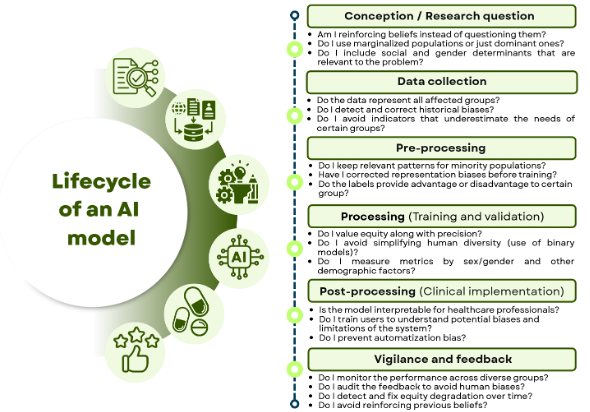
Figure 1. Key questions for identifying and mitigating sex and gender bias throughout the AI model lifecycle. Adapted and translated from Saldívar-González & Murrieta (2025), licensed under CC BY 4.0.
Bias can occur at all phases of the AI lifecycle: data collection, preprocessing, feature selection, model training, validation, deployment, and clinical interpretation. Thus, creating fair and equitable AI systems requires more than just dataset balancing. Transparent model development, ongoing performance evaluation across diverse populations, appropriate fairness metrics, and collaboration among computational scientists, clinicians, and social scientists are essential factors. Figure 1 offers a structured set of guiding questions for each phase of the AI lifecycle, aimed at identifying and addressing sex- and gender-related biases in AI development and implementation.
Recent advances in AI provide promising opportunities to reduce these inequalities. Data augmentation techniques have improved the representation of underrepresented populations in medical imaging datasets, while machine learning approaches such as AwareDX help identify sex-specific adverse drug reactions by balancing pharmacovigilance data (Chandak & Tatonetti, 2020). Fairness-oriented tools including D-BIAS (Ghai & Mueller, 2022) and Aequitas (Saleiro et al., 2019) enable developers to detect and quantify algorithmic bias during model development. Ethical frameworks such as FAIRS further assist researchers in determining when including sex or gender variables improves clinical performance and when it may unintentionally reinforce discrimination (Bellamy et al., 2019). Additionally, initiatives promoting diversity within data science and AI research teams contribute to the development of more inclusive computational systems.
These findings highlight the necessity of incorporating strategies that consider biological, social, and cultural variations to mitigate the effects of the historical underrepresentation of women and other marginalized groups in biomedical research.
While this challenge encompasses more than just technology, AI-driven initiatives serve as a crucial initial step in recognizing and tackling these disparities. AI can identify data gaps, aiding in the collection of more representative datasets and informing future model design. These efforts can help close knowledge gaps, reduce health disparities, and promote a more equitable approach to biomedical research and drug discovery.
References:
Allegra, S., Chiara, F., Di Grazia, D., Gaspari, M., & De Francia, S. (2023). Evaluation of Sex Differences in Preclinical Pharmacology Research: How Far Is Left to Go? In Pharmaceuticals, 16, (6). https://doi.org/10.3390/ph16060786
Bellamy, R. K. E., Dey, K., Hind, M., Hoffman, S. C., et al. (2019). AI Fairness 360: An Extensible Toolkit for Detecting, Understanding, and Mitigating Unwanted Algorithmic Bias. IBM Journal of Research and Development, 63, (4/5), 4:1-4:15. https://doi.org/10.1147/JRD.2019.2942287
Betai, D., Ahmed, A. S., Saxena, P., Rashid, H., Patel, H., Shahzadi, A., Mowo-wale, A. G., & Nazir, Z. (2024). Gender Disparities in Cardiovascular Disease and Their Management: A Review. Cureus. https://doi.org/10.7759/cureus.59663
Bianco, A., Antonacci, Y., & Liguori, M. (2023). Sex and Gender Differences in Neurodegenerative Diseases: Challenges for Therapeutic Opportunities. In International Journal of Molecular Sciences , 24(7). https://doi.org/10.3390/ijms24076354
Chandak, P., & Tatonetti, N. P. (2020). Using Machine Learning to Identify Adverse Drug Effects Posing Increased Risk to Women. Patterns, 1(7). doi: https://doi.org/10.1016/j.patter.2020.100108
Chung, H., Park, C., Kang, W. S., & Lee, J. (2021). Gender Bias in Artificial Intelligence: Severity Prediction at an Early Stage of COVID-19. Frontiers in Physiology, 12. https://doi.org/10.3389/fphys.2021.778720
Ghai, B., & Mueller, K. (2022). D-BIAS: A Causality-Based Human-in-the-Loop System for Tackling Algorithmic Bias. IEEE Trans. on Visualization and Computer Graphics, 29(1):473-482. https://doi.org/10.1109/TVCG.2022.3209484
Osborne, N. R., & Davis, K. D. (2022). Sex and gender differences in pain. In International Review of Neurobiology, 64,277–307. https://doi.org/10.1016/bs.irn.2022.06.013.
Saldívar-González, F. I., & Murrieta, A. C. (2025). Un reto para la Inteligencia Artificial y el diseño de fármacos. Revista Espacios Transnacionales. 24, 12-27. https://espaciostransnacionales.xoc.uam.mx.
Saleiro, P., Kuester, B., Hinkson, L., London, J., Stevens, A., Anisfeld, A., Rodolfa, K. T., & Ghani, R. (2019). Aequitas: A Bias and Fairness Audit Toolkit. http://arxiv.org/abs/1811.05577
Sau, A., Sieliwonczyk, E., Patlatzoglou, K., Pastika, L, et al. (2025). Artificial intelligence-enhanced electrocardiography for the identification of a sex-related cardiovascular risk continuum: a retrospective cohort study. The Lancet Digital Health, 7(3), e184–e194. https://doi.org/10.1016/j.landig.2024.12.003
Yoon, D. Y., Mansukhani, N. A., Stubbs, V. C., Helenowski, I. B., Woodruff, T. K., & Kibbe, M. R. (2014). Sex bias exists in basic science and translational surgical research. Surgery (United States), 156(3), 508–516. https://doi.org/10.1016/j.surg.2014.07.001
Fernanda I. Saldívar González earned her B.Sc. in Pharmaceutical Chemistry and her Ph.D. in Chemical Sciences from the Universidad Nacional Autónoma de México (UNAM). She is currently a postdoctoral researcher at the Institute for Obesity Research, Tecnológico de Monterrey. Her research focuses on computer-aided drug design and the development of cheminformatics tools for the analysis and optimization of bioactive compounds.
Ana C. Murrieta is a doctoral candidate in Nanotechnology at Tecnológico de Monterrey. She has been recognized by the International Centre for Diffraction Data for her contributions to the structural characterization of polycrystalline nanomaterials. Her current research focuses on computational drug discovery for metabolic diseases through machine learning, cheminformatics and molecular modeling
